
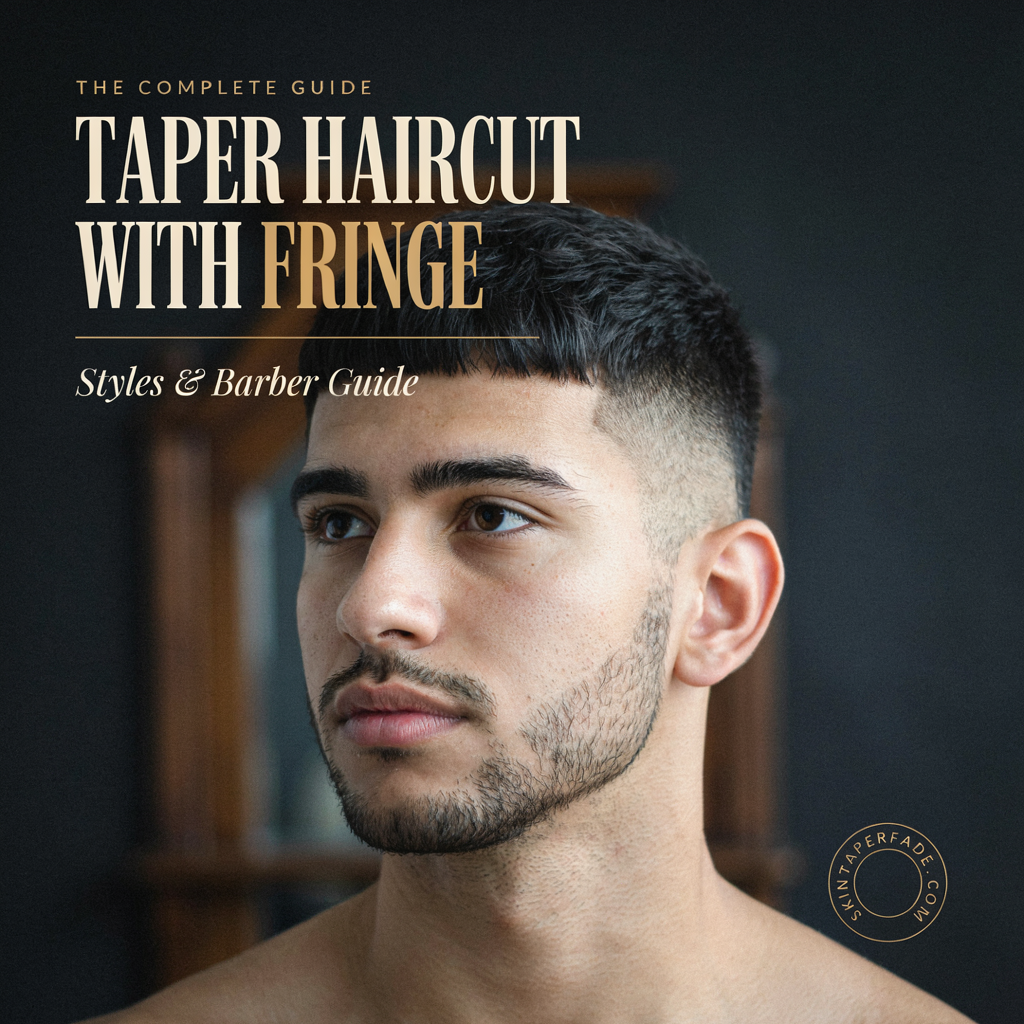
A taper haircut with fringe combines a tidy outline with hair worn forward across the forehead. The sides and neckline gradually shorten, while the front stays long enough to create the shape you want. That could be a short textured fringe, a fuller curly front or a longer side-swept style.
The combination offers plenty of choice, but the fringe deserves as much planning as the taper. Its length, weight and direction determine how the haircut looks from the front and how easily you can style it. A neat blend at the sides will not solve a fringe that fights your growth pattern every morning.
This guide helps you choose both parts together. For the broader family of cuts, see our complete guide to taper haircuts for men.
Taper Haircut with Fringe
What is a taper haircut with fringe?
A taper gradually shortens the hair towards the lower sides and back. A fringe is the front section worn towards or across the forehead. Pairing them lets you keep movement at the front while controlling the outline around the ears and neck.
The taper can be classic and soft or closer around the temples and nape. It does not have to reach skin. The fringe can be blunt, broken up with texture, curly, wavy or swept diagonally.
This is a combination of haircut features rather than one fixed style. A French crop, a loose textured top and a longer fringe can all have tapered edges, yet produce different results.
Taper fringe vs full fade with fringe
A taper often preserves more hair through the sides and concentrates its shortest areas at the edges. A full fade usually shortens a broader section around the sides and back. Barber terminology varies, so bring a side-view reference showing the coverage you want.
If you like fuller upper sides beside the fringe, say so. If you want the front to sit above very close sides, show that stronger contrast instead.
Choosing the fringe first
Start by deciding where you want the front to sit when dry. A short fringe above the eyebrows has a different character from a longer fringe that can be pushed sideways. Also decide whether you want a solid edge or visible separation.
| Fringe type | General appearance | What to discuss |
|---|---|---|
| Short textured fringe | Broken, light-looking front | How much separation suits your density |
| Blunt fringe | A deliberate, more solid line | Dry length, weight and how it follows the forehead |
| Curly fringe | Curls falling forward | Shrinkage and the finished dry position |
| Wavy fringe | Looser movement across the front | Length needed for the wave to form |
| Side-swept fringe | Hair travelling diagonally | Natural growth direction and styling effort |
| Longer loose fringe | More movement and versatility | Whether it should clear the eyes or be swept aside |
A fringe can visually reduce the amount of forehead shown, but that does not mean it must cover every corner. Ask your barber how to shape the front around your natural hairline.
Low, mid or high taper with a fringe?
Low taper with fringe
A low taper stays near the sideburns and neckline, preserving more side fullness. It can support a loose fringe or rounded top without creating a large closely cropped section beneath it. This is a useful starting point if you want a restrained outline.
Mid taper with fringe
A mid taper rises farther around the temples and nape. It makes the blend more visible and the fringe more prominent. Check how the hair above the taper connects to the front so the shape looks deliberate from the side.
High taper with fringe
A higher blend creates stronger contrast. It can frame a compact crop or fuller front, but removing too much temple hair may change how the fringe corners sit. Some references show a full high fade rather than a targeted taper, so confirm the coverage.
Skin finish is a separate choice. You can keep a low taper that reaches skin or a higher taper with visible hair at the bottom. Explore close finishes in our skin taper fade guide.
Eight taper haircut styles with a fringe
1. Taper with a short textured fringe
Keep the front compact and cut it with visible separation rather than a heavy, straight edge. A low or mid taper tidies the perimeter. Tell your barber if you want to style it with your fingers rather than spend time arranging every strand.
2. Taper with a French crop fringe
A French crop typically combines a compact top with a short forward fringe. A taper can provide a softer side finish than a broad skin fade. Agree on whether the fringe should look blunt or lightly textured, because those versions feel different from the front.
3. Taper with a longer textured fringe
Keep more length through the front for movement and a less rigid outline. The top needs a planned connection into that longer area. Ask where the fringe will sit without styling so the reference remains practical for ordinary days.
4. Taper with a curly fringe
Let the front curls fall forward while the temples and neckline stay defined. Leave enough length for the dry result and avoid cutting the corners short simply to make the wet fringe look even. See our taper haircut with curly hair guide.
5. Taper with a wavy fringe
Preserve enough front length for natural movement to form. A low taper can keep the upper sides connected and the whole cut softer. Tell your barber whether you wear the wave forward or push it slightly to one side.
6. Taper with a side-swept fringe
Direct the front diagonally rather than straight down. This may fit hair that naturally parts or grows sideways. Agree on the shorter and longer corners, and ask how much drying or product will be needed to keep the shape.
7. Taper with a blunt fringe
A more solid front edge creates a defined silhouette. The line should account for your forehead, density and growth direction. A blunt finish can look heavy on dense hair, so discuss weight above the edge as well as the line itself.
8. Taper with a loose, fuller fringe
Keep enough length and volume for a relaxed front. A small temple taper can sharpen the outline while leaving the upper sides full. Fuller-looking styles may rely on drying and styling, so explain how much effort you want to put in.
Choosing a fringe for your hair type
Straight hair
Straight hair can show the fringe edge clearly. It works with a deliberate blunt line or a softer textured finish. If your front grows upward or parts strongly, ask your barber how the length should account for that. More guidance is available in our taper haircut with straight hair article.
Wavy hair
Leave enough length for the wave to sit naturally. A rigid short line may behave differently once the wave returns after washing. Ask the barber to check how the front falls when dry.
Curly or coily hair
The front’s dry position matters more than its stretched length. Curls and coils may sit at different heights across the forehead. Choose the shape in its natural state and account for shrinkage before removing length.
Fine hair
A fringe can be shaped lightly, but removing too much weight may make it look sparse. Ask for texture suited to your density and start with modest styling product amounts. A fuller-looking reference may have much denser hair than yours.
Dense hair
Discuss the weight behind the fringe as well as the front line. A taper cleans the sides but does not automatically stop a heavy front from sitting flat. Weight management should preserve the shape rather than thin every area indiscriminately.
Cowlicks and front growth direction
A fringe is easier to manage when its cut considers where the hair wants to go. If the front lifts, splits or falls to one side, show your barber before it is reshaped or heavily styled.
They may suggest a different length, a softer fringe or a side-swept direction. Cutting shorter does not always make a cowlick easier to control; it can expose the growth pattern more clearly. Ask how the fringe will sit on a day when you do not use a dryer.
How long should the fringe be?
There is no one measurement for every taper fringe haircut. Your hair texture, growth direction and preferred coverage determine the required length.
Use a visible landmark: “above my eyebrows,” “just touching the brows when dry,” or “long enough to sweep aside.” For curls, specify the dry position. If you wear glasses, mention whether the fringe should clear the frames.
Start conservatively if you are uncertain. A barber can shorten the front during the appointment, but cannot restore length after cutting it off.
What to ask your barber for
Bring photos of the front, side and back. You can say:
“I’d like a taper haircut with a [short textured / blunt / curly / side-swept] fringe. Keep the taper [low / mid], with [visible hair / skin] at the bottom. Leave enough upper-side weight to connect into the top, and keep the fringe [your preferred position] when dry.”
Then confirm:
- Fringe position: Where should it sit without being stretched or heavily styled?
- Front edge: Solid, softly textured or naturally curled?
- Growth direction: How will a part or cowlick affect the cut?
- Taper coverage: Which temple and nape areas should be shortened?
- Daily routine: Will you air-dry, finger-style or use a dryer and product?
A line-up is separate from the fringe. If you want a sharply outlined temple corner, discuss it without assuming that the forehead edge also needs reshaping.
Styling a taper haircut with fringe
Work with the haircut’s intended direction. Start with a small amount of product and add more only if needed.
Textured fringe: Arrange the front forward and separate it with your fingers using an appropriate matte product. Avoid coating it so heavily that it loses movement.
Blunt fringe: Guide the front into place while damp. Check the edge once dry rather than repeatedly trimming or pulling it flat yourself.
Curly or wavy fringe: Shape the natural pattern with a suitable routine and let it settle. Excessive disturbance while drying can change the intended definition.
Side-swept fringe: Direct it along the agreed diagonal. If drying is needed, use a comfortable setting and follow product and tool instructions.
The taper itself usually needs little daily arrangement. Most of the work is at the front, so choose a fringe that fits the effort you are willing to make.
Maintenance and growing out the fringe
The front and tapered edges may need attention at different times. A skin-short outline becomes less crisp as stubble returns, while the fringe can grow into the eyes or lose its intended shape.
Check both after a couple of weeks. You may need a fringe trim without shortening the entire top, or a temple and nape tidy while leaving the front to grow. Explain that distinction when booking or sitting down.
If you are growing the fringe longer, tell your barber to preserve length and only adjust the shape needed to keep it wearable. Avoid cutting straight across it at home just because a few strands seem longer; texture and natural movement can make the front look uneven when pulled out of position.
Common mistakes to avoid
Choosing a taper but leaving the fringe vague. The front needs its own length, direction and finish instructions.
Cutting a curly fringe to its wet position. Account for how it sits when dry.
Ignoring a strong part or cowlick. The style should work with your growth pattern or include a realistic routine for redirecting it.
Removing too much weight from fine hair. Texture should suit density rather than copy a thick-haired reference exactly.
Taking the temple taper too wide. That can affect the corners and connection of a fuller fringe.
Choosing a high-effort front without planning the routine. A photo may involve careful drying and more styling than you want each day.
Frequently asked questions
Can you have a fringe with a taper haircut?
Yes. The taper shapes the sides and back while the fringe determines how the front is worn. You can choose their lengths separately and connect them into one silhouette.
Is a low taper suitable for a textured fringe?
Yes. It can keep the edges tidy while retaining upper-side fullness. A mid taper gives more visible contrast if that is the look you prefer.
Does a taper fringe haircut have to show skin?
No. Ask for visible hair at the shortest point if you prefer a softer finish. Skin is an optional bottom length.
How long should my fringe be?
Long enough for the shape and coverage you want, accounting for texture and growth direction. Describe where it should sit when dry rather than relying on a universal measurement.
Can curly hair have a taper with fringe?
Yes. Preserve enough front length for shrinkage and decide how much curl volume you want at the upper sides.
Will a fringe work with a cowlick?
It may, but the length and direction need adapting. Ask your barber how it will sit naturally and how much styling it will require.
Can I keep the fringe longer while refreshing the taper?
Yes. Ask for edge maintenance without unnecessarily shortening the front. You may still need occasional shaping to keep the growing fringe manageable.
Choosing your taper and fringe
A taper haircut with fringe works best when the front and sides are planned together. Choose the dry fringe position, agree on its weight and direction, then fit the taper around the shape you want to keep. Clear photos and an honest conversation about styling help make the cut practical beyond the barber chair.
Explore more placements in our taper haircuts for men guide.