
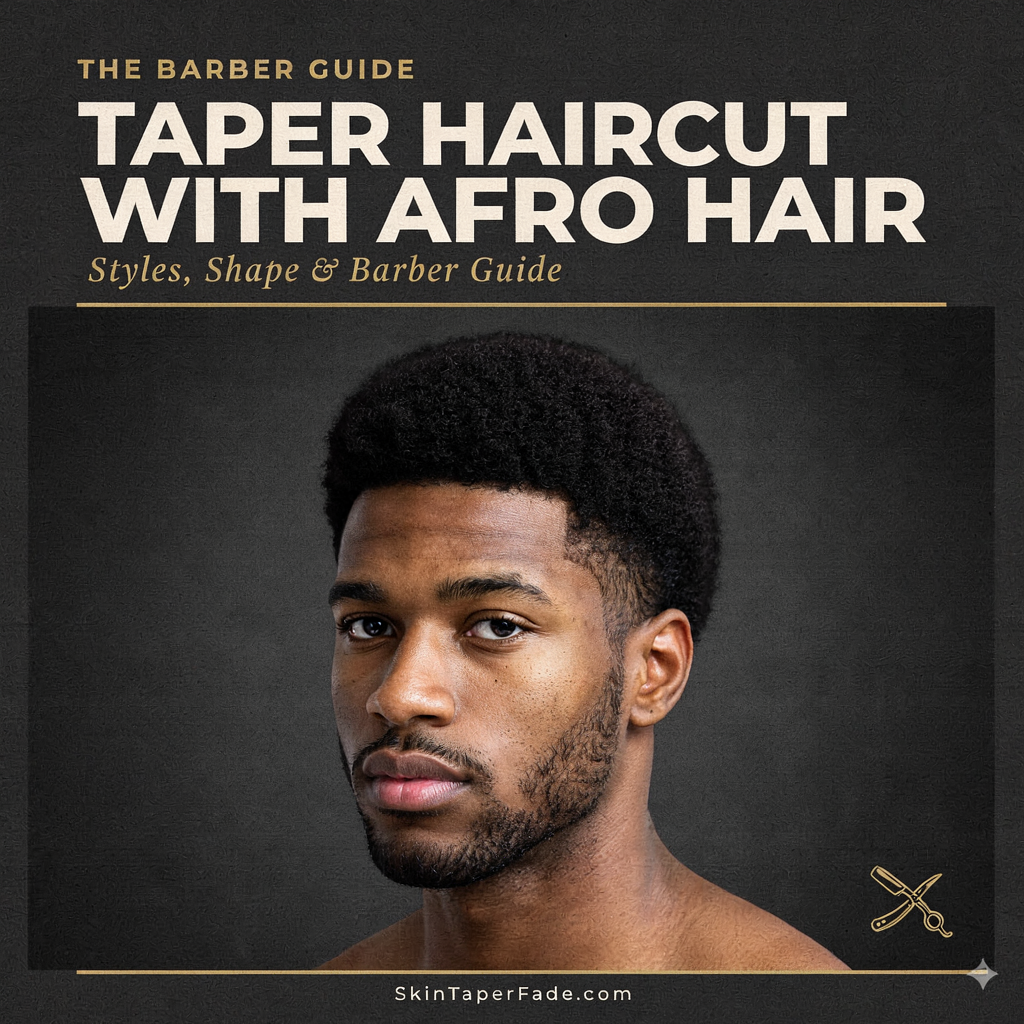
A taper haircut with Afro hair can tidy the temples and neckline while keeping the volume and texture that define your style. The top can remain rounded, compact or taller through the centre. The edges can stay soft or blend down to skin.
The best result starts with the whole shape. If you want a full Afro, the taper should support its width rather than remove it by accident. If you prefer a smaller, more sculpted top, a closer blend can help create that contrast. Either way, the amount of hair you keep matters as much as the amount you cut.
This guide explains placements, styling options, hairline choices and barber instructions. For the broader haircut family, see our complete guide to taper haircuts for men.
Taper Haircut with Afro Hair
What is a taper haircut with Afro hair?
A taper gradually shortens the hair towards the lower sides and back. With Afro textured hair, that transition can frame a fuller top, define the sideburns or clean the nape without removing all the surrounding volume.
“Afro hair” is often used to describe tightly curled or coily textures, while an “Afro” also describes a hairstyle worn with natural fullness. Neither term means every person’s hair behaves the same way. Density, strand thickness, curl pattern, shrinkage and growth direction all affect the finished shape.
A taper can remain non-skin at the shortest point or reach bare skin. It can also be narrow and localised or cover more of the lower sides. Those choices should be agreed separately.
Tapered Afro vs Afro fade
In common usage, a tapered Afro preserves more fullness through the sides and focuses the shortest work near the edges. An Afro with a fade often has a broader closely cropped section around the sides and back. The words overlap between barbershops, so show the coverage you want in a photo.
If preserving width is your priority, point to the upper sides and say so before the cut starts.
Low, mid and high taper options
Low taper with Afro hair
A low taper keeps the short blend near the sideburns and neckline. It can define the perimeter while preserving a rounded silhouette. This is a useful option when you like a fuller Afro and want the edges sharpened rather than the entire side reduced.
Mid taper with Afro hair
A mid taper rises farther around the temples and nape. It creates a more visible transition and makes the top more prominent. Agree on how much width should remain above the blend, especially if your reference has a rounded top.
High taper with Afro hair
A higher taper creates stronger contrast and takes more fullness from the temple area. It can suit a taller or narrower shape, but some photos labelled high taper are actually full high fades. Check the side and back views carefully.
| What you want to preserve or emphasise | Starting point to discuss |
|---|---|
| Rounded fullness at the sides | Low, narrow taper |
| More visible edge definition | Mid taper |
| Height through the top | Higher taper with coverage agreed |
| A softer bottom edge | Non-skin finish |
| A bare-skin starting point | Skin taper |
Placement names are approximate. Your barber should adapt the height to your natural hairline and the shape above it.
Skin finish or soft taper?
A skin taper takes the shortest part to bare skin. It gives the edge a clearer contrast and changes appearance as stubble grows back. You can keep that skin area small and low; it does not have to continue around the entire side.
A soft, non-skin taper retains visible hair at the bottom. It can give you a gradual outline without a strongly exposed section. Ask for it if you want a less dramatic finish or prefer not to have the edges cut extremely close.
Read our skin taper fade guide to compare close finishes.
Eight taper styles for Afro hair
1. Low taper with a rounded Afro
Preserve the top and upper-side volume, then taper the lowest edges. The barber can shape the outline so the Afro looks balanced from the front, side and back. Ask to see the width before taking the temple blend higher.
2. Short Afro taper haircut
Keep the main shape compact while retaining enough length to show your texture. A short top does not mean every section needs the same length. Ask the barber to adapt the crown and front to your growth pattern.
3. Mid taper with a shaped top
A more visible blend can frame a deliberately sculpted silhouette. Choose the top’s width and height first, then agree on the transition beneath it. A smooth connection and a pronounced disconnect are different looks.
4. Temple taper with a fuller Afro
A small temple taper tidies the sideburn area while leaving most of the sides intact. Decide separately whether the neckline should also be tapered. This is useful when you mainly want a cleaner front frame.
5. Neck taper with natural volume
A neck taper can define the base while preserving a fuller back. Ask for a low blend if you want the rounded outline to continue close to the nape.
6. Taper with defined coils
Keep enough length for the texture you normally wear and taper the perimeter around it. Tell your barber whether you style the hair with visible coil definition or wear it picked out, because the same cut can appear different in those states.
7. Taper with a taller Afro top
Height becomes the focal point while the edges narrow beneath it. Show how much width you want retained so the barber does not make the top slimmer than intended. Choose a reference with density reasonably similar to yours.
8. Afro taper with a beard
The sideburn can blend into the beard. Agree on whether the beard should remain full or receive its own fade near the cheeks. A sharp cheek line, beard neckline and temple line-up are separate choices.
Natural hairline or line-up?
A line-up defines the forehead edge and temple corners. It is optional. You can have a clean taper while leaving the front hairline natural.
If you want a line-up, ask the barber to follow the existing hairline rather than pushing it back to create an artificially straight edge. Naturally different corners can be balanced without repeatedly moving both farther back. Tell the barber whether you like a crisp outline or a softer frame.
A sharp line-up becomes less defined as the hair grows. A natural edge may suit you better if you prefer less frequent tidying. Neither option is required for an Afro taper to look intentional.
Shape, density and shrinkage
The overall silhouette depends on more than the stretched length of the hair. Afro textured hair can look much shorter in its natural state, and different sections may shrink differently.
If you wear your hair picked out: Explain the rounded shape you want after it is lifted and arranged.
If you wear defined coils: Show how they normally sit and how much front or side movement you want.
If the hair is very dense: Ask where weight needs managing while preserving the main shape. A taper cleans the edges but does not automatically address bulk above them.
If density varies: Ask the barber to adapt the outline rather than force every section to a length that exposes the variation.
There is no universal top length for this haircut. A reference with similar texture and density, plus a discussion about your normal styling, is more useful than a fixed measurement alone.
Preparing for the barber appointment
Choose a barber comfortable working with Afro textured hair. Check their portfolio for cuts that preserve texture and have the kind of shape you want.
Ask whether they prefer the hair detangled, picked out or in its usual styled state when you arrive. Follow their preparation instructions and tell them about products that affect how the hair sits. Do not assume every barber uses the same preparation or cutting method.
Bring front, side and back references. Explain which feature you like in each rather than expecting several different cuts to combine automatically.
What to ask your barber for
You can say:
“I’d like a taper haircut that keeps my Afro full and rounded above the blend. Keep the taper [low / mid] around the temples and neckline, with the shortest section [still visible / down to skin]. Please preserve this width at the sides and keep my front hairline [natural / neatly lined up without moving it back].”
Adjust the rounded-shape instruction if you want a taller or more compact top. Confirm:
- Silhouette: Rounded, compact, taller or more sculpted?
- Width: How much fullness should stay at the upper sides?
- Coverage: Temples and nape only, or more of the sides?
- Shortest finish: Skin or visible hair?
- Styling state: Picked out, defined coils or another everyday finish?
Before leaving, check the back with a mirror and the top in the state you intend to wear it. Ask about any area that looks higher or narrower than agreed.
Styling and everyday care
Build your routine around your own texture and scalp rather than a fixed schedule for all Afro hair. Cleanse as needed for your activity and product build-up, and use conditioning or styling products that suit how you wear the hair.
Detangle gently with suitable tools and enough slip for your hair. Work through sections rather than forcing a comb through knots. If you wear a picked-out shape, lift and arrange it with care rather than repeatedly pulling through the same area.
For defined coils, use an appropriate styling approach and allow the shape to settle before adjusting it. Start with modest product amounts; repeated layering can leave build-up without improving definition.
The tapered edges usually need little daily styling. Most of the work is maintaining the top shape. Tell your barber how much time you want to spend so the cut fits your routine.
Keeping the taper fresh while growing the top
You can maintain the temples and nape while allowing the main Afro to grow. Ask for an edge refresh and only the shaping needed to keep the outline balanced. Make clear that length growth is your priority.
A skin finish becomes less crisp as stubble returns, while a soft taper grows fuller more gradually. Check the shape after a couple of weeks and decide whether only the edges need attention or the overall silhouette needs adjusting.
Avoid taking the taper higher yourself to chase a clean edge. That can remove the side fullness you are trying to grow. A line-up tidy and a full reshaping are different requests, so agree on which one you need.
Common mistakes to avoid
Choosing taper height before the overall shape. Decide what stays above the blend first.
Treating all Afro textures as identical. Density, shrinkage and growth direction affect the result.
Pushing the hairline back for a sharper corner. Ask for an outline that respects the natural edge.
Removing too much width. A broad blend can change a rounded Afro into a narrower top.
Using a reference with very different density. Treat it as an idea to adapt rather than a guaranteed copy.
Shortening the top at every edge refresh. Tell the barber if you are growing the main shape.
Frequently asked questions
Is a taper haircut suitable for Afro hair?
Yes. It can define the edges while preserving texture and volume above. The placement should support the shape you want rather than remove fullness unnecessarily.
Is a low taper better than a high taper for an Afro?
A low taper generally keeps more lower-side fullness. A higher taper creates more contrast and can emphasise a taller top. Choose according to your preferred silhouette.
Does an Afro taper need a line-up?
No. A natural front hairline and a sharp line-up are separate options. Either can be paired with a taper.
Can I keep a large Afro with a taper?
Yes. Ask for a low, targeted blend and specify the width and height you want preserved. Show the side and back outline as well as the front.
Can the taper go down to skin?
Yes. Ask for a skin finish at the shortest point and agree on how much of the temple and nape area should show skin.
Can I grow the top while keeping the edges tidy?
Yes. Ask for edge maintenance without unnecessarily shortening the main shape. Occasional shaping may still help keep the growing outline balanced.
How often should I refresh an Afro taper?
It depends on your growth rate and preferred definition. A skin finish or sharp line-up becomes less crisp sooner than a soft taper. Use the first grow-out to choose a schedule that suits you.
Choosing your Afro taper
A taper haircut with Afro hair works best when the edges support the volume above them. Decide on the silhouette, preserve the width you like and choose the shortest finish separately from the placement. Clear photos and a conversation about your everyday styling help your barber shape the cut around your hair.
Explore more options in our taper haircuts for men guide.