
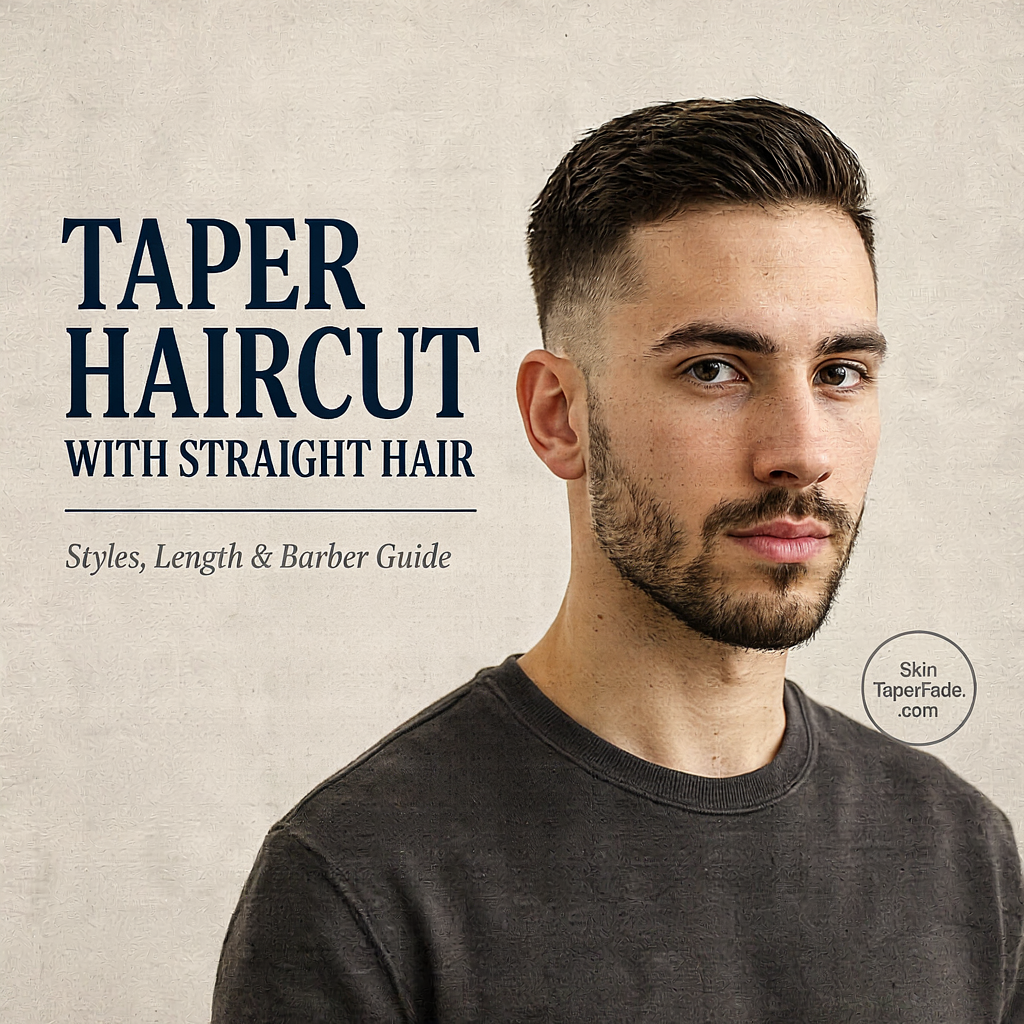
A taper haircut with straight hair gives the sides and back a gradual finish while leaving plenty of choice on top. You can wear a short crop, neat side part, loose fringe or longer swept-back style. The taper simply helps those lengths connect into a cleaner outline.
Straight hair can make changes in length easy to see. That is useful when the blend is smooth, but it can also reveal a heavy shelf above the ears or a short section that sticks out. The answer is not always to cut higher. It is to choose lengths that work with the direction your hair grows.
This guide explains the options, practical styling and what to discuss with your barber. For the full haircut family, see our complete guide to taper haircuts for men.
Taper Haircut with Straight Hair
What is a taper haircut for straight hair?
A taper gradually reduces hair length towards the lower sides and neckline. It can be a soft, classic blend through the sides or a closer transition focused at the temples, sideburns and nape. The top is shaped separately.
Straight hair does not need curls or waves for a taper to work. Its natural direction, density and strand thickness influence which lengths sit neatly. Some straight hair lies flat, while other straight hair grows outward strongly. Your barber should assess those characteristics rather than treating all straight hair the same.
Taper vs fade on straight hair
In common barbershop usage, a taper often retains more hair on the sides and concentrates its shortest work near the edges. A fade usually shortens a broader area around the sides and back. Both involve a transition between lengths, and the labels overlap.
If you want combable upper sides, say so. If you want most of the side cut close, show a reference of that broader finish. A photo communicates the coverage more reliably than the name alone.
Choosing the taper placement
Classic taper
A classic taper leaves visible length through the sides, gradually shortening towards the ears and neck. It suits a connected haircut where the top and sides flow together, such as a side part or short scissor cut. Ask how much length should remain to follow your natural growth direction.
Low taper
A low taper keeps the closest blend near the sideburns and neckline. It preserves more side fullness and can frame a crop or longer fringe without removing the upper sides. It is a useful starting point if you want a small change.
Mid taper
A mid taper rises farther around the temples and nape. The transition becomes more visible and the top more prominent. Agree on what should happen to the weight immediately above the blend so it does not form an unintended ledge.
High taper
A higher taper creates stronger contrast and removes more hair near the temples. Some references labelled high taper show a full high fade, so check how much side hair remains. The higher placement does not automatically mean a skin finish.
| Your priority | Starting point to discuss |
|---|---|
| A soft, connected haircut | Classic taper |
| Keep most of the sides full | Low taper |
| Show more of the blend | Mid taper |
| Emphasise a prominent top | Higher taper with coverage agreed |
| Keep visible hair at the bottom | Non-skin finish |
| Create a bare-skin starting point | Skin taper |
Skin or non-skin finish?
A skin taper takes the lowest area to bare skin. It creates contrast even when the tapered section is small. A non-skin taper leaves visible hair at the bottom for a gentler finish.
Choose the shortest length separately from the height. “Low skin taper” describes a low placement with a very close bottom; “mid taper with hair left at the bottom” describes a higher but softer blend.
Explore close finishes in our skin taper fade guide.
Eight taper haircut styles for straight hair
1. Taper with a textured crop
A textured crop leaves the top relatively short with separation through the front. The taper cleans the outline. Ask for texture that suits your density: fine hair may need a lighter approach, while dense hair may need more careful weight management. A textured cut adds shape and separation rather than turning naturally straight hair curly.
2. Classic taper with a side part
Keep enough upper-side length to comb into the part. Let the part follow your natural direction where possible. A low, non-skin taper creates a restrained finish; a small skin taper gives it more contrast. A shaved part line is optional and should be discussed separately.
3. Taper with a short quiff
Leave extra length at the front for lift and keep the rest compact. A short quiff can be easier to style than a tall one, especially if your hair naturally falls forward. Tell the barber whether you are willing to use a dryer each morning.
4. Taper with a straight fringe
Wear the front forward, either softly textured or more bluntly shaped. The temples can be tapered while the upper sides stay connected. Agree on where the fringe should sit when dry and whether it needs to clear the eyebrows.
5. Taper with curtains or a middle part
Keep sufficient length for the front to separate and fall to either side. A low taper can tidy the perimeter while preserving the longer shape. If your hair strongly parts off-centre, ask how easily the style will sit before committing to a symmetrical reference.
6. Taper with a crew cut
Keep the top short, often with slightly more length towards the front, and blend the sides gradually. It can offer a simple routine, but the crown and fringe should be adapted to your growth pattern. A cowlick may behave differently when cut very short.
7. Taper with a swept-back top
Leave enough length for the hair to travel backwards. The sides can remain combable or be more closely shaped. Ask whether the top will stay back naturally or need consistent drying and product; the photograph may show much more styling than you want to do.
8. Taper with a beard
The sideburn can connect into beard hair. Explain whether you want just the connection blended or the beard itself faded too. Beard density and length affect the result, so agree on how much fullness stays below the taper.
Fine, dense and coarse straight hair
“Straight” describes the pattern, not how much hair you have or how thick each strand is. Those details matter when choosing the shape.
Fine straight hair
Heavy styling products can flatten a fine top. Consider a shorter textured style or a side part that works with the natural fall. Ask the barber how much upper-side weight to retain before selecting a very close blend. A haircut can change the appearance of fullness, but it does not increase hair density.
Dense straight hair
A taper clears the edges, but the hair above may still need shaping. Tell your barber where the sides feel bulky between cuts. Simply taking the taper higher may not solve the underlying connection between the sides and top.
Coarse straight hair that grows outward
Some hair stands away from the head at certain lengths. Your barber may suggest either a closer cut or enough length for it to settle, depending on the style. Ask which approach fits the shape you want rather than assuming one guard length works universally.
Straight hair with a crown cowlick
Show the barber how your crown normally sits. Cutting it shorter can expose the growth direction; leaving it longer may help it lie differently. The right choice depends on your own pattern, so check the crown as well as the front reference.
How to manage sides that stick out
If your sides flare shortly after a haircut, explain the timing and location. Does it happen directly above the ear, near the crown or along the connection to the top? That tells the barber which area needs attention.
Ask whether the problem is length, bulk or a disconnected blend. The solution may involve keeping more length, cutting closer or shaping the transition. Removing weight should be targeted; taking too much from fine hair can leave the area looking sparse.
Check the finished haircut when dry. Damp hair can lie flatter than it does during an ordinary day.
What to ask your barber for
Bring front, side and back photos showing hair similar to yours. You can say:
“I’d like a taper haircut with [a textured crop / a side part / a longer fringe] on top. Keep the taper [classic and soft / low / mid], and leave enough upper-side length to sit neatly. I want the bottom [still visible / down to skin]. My sides tend to stick out here, so please account for that when shaping the blend.”
Confirm:
- Top length and direction: Forward, parted, lifted or swept back?
- Side connection: Smoothly connected or intentionally contrasted?
- Taper height and width: Which areas will be shortened?
- Bottom finish: Bare skin or visible hair?
- Neckline and hairline: Natural, tapered or more sharply outlined?
A temple taper can be requested separately if you mainly want the front edges tidied. A neck taper handles the nape. Neither request automatically determines the top.
A simple styling routine
Start with the style the haircut was designed for. A neat side part and a loose crop need different approaches.
For a textured crop: Distribute a small amount of suitable matte product through the top and separate it with your fingers. Add more only if necessary.
For a side part: Comb the hair along its natural part and use enough hold for the finish you want. A softer style may need less product than a highly polished one.
For a quiff or swept-back top: Dry the hair in the intended direction on a comfortable setting, then add product for hold. Product alone may struggle to redirect a strong forward growth pattern.
For a longer fringe or curtains: Arrange the part or front while damp and let the hair settle. Use light control if heavier product pulls it flat.
Follow product instructions and start with modest amounts. If you want almost no daily styling, tell your barber before choosing a long or highly sculpted top.
How often should you refresh the taper?
The right schedule depends on how fast your hair grows and how sharp you like the edges. A skin finish becomes less defined as stubble returns. A classic taper can grow fuller more gradually, although straight hair may reveal side bulk as its length changes.
Check the shape after a couple of weeks. If the top is still right but the edges need attention, ask about a tidy-up rather than automatically shortening everything. If the upper sides are flaring, discuss that area at the next appointment.
Common mistakes to avoid
Copying a reference with different density. Adapt the style to the amount and behaviour of hair you have.
Taking the taper higher to solve every bulky area. The top-to-side connection may need shaping instead.
Ignoring growth direction. A fringe, part or quiff is easier to manage when its direction is considered during the cut.
Using too much product. Excess can flatten fine hair or hide the separation you wanted.
Assuming a skin finish is compulsory. Placement and bottom length are separate decisions.
Choosing a style without discussing the morning routine. A photograph may depend on careful drying and product application.
Frequently asked questions
Does a taper haircut work with straight hair?
Yes. It can create a gradual outline and pair with short or longer tops. Your growth direction, density and preferred styling routine help determine the best shape.
Is a low taper a good choice for straight hair?
It can be, particularly if you want to preserve upper-side length. If the sides grow outward, ask your barber to plan their length and connection rather than choosing purely by taper height.
Can I get a taper without showing skin?
Yes. Ask for visible hair at the shortest point. A non-skin taper gives a softer bottom edge.
Will a taper make straight hair curly?
No. It changes the haircut’s shape and outline. Texture cut into the top can add separation, but it does not change the natural hair pattern.
How much top length do I need?
It depends on the style. A crew cut needs less than a swept-back top or curtains. Explain the result you want and ask how your growth direction affects the required length.
Can fine straight hair have a taper?
Yes. Discuss a shape that keeps the balance you prefer and avoid removing weight unnecessarily. A lighter styling approach may suit the top.
Why do my sides stick out after a taper?
Hair may stand outward at certain lengths, or the transition above the taper may retain too much bulk. Show your barber where it happens so they can adapt the next cut.
Choosing your straight-hair taper
A taper haircut with straight hair works best when its lengths follow the way your hair behaves. Decide on the top first, agree on how much side fullness to keep and choose the taper’s height and shortest finish. A clear reference and an honest discussion about styling make the haircut easier to wear after the appointment.
Compare more options in our taper haircuts for men guide.