
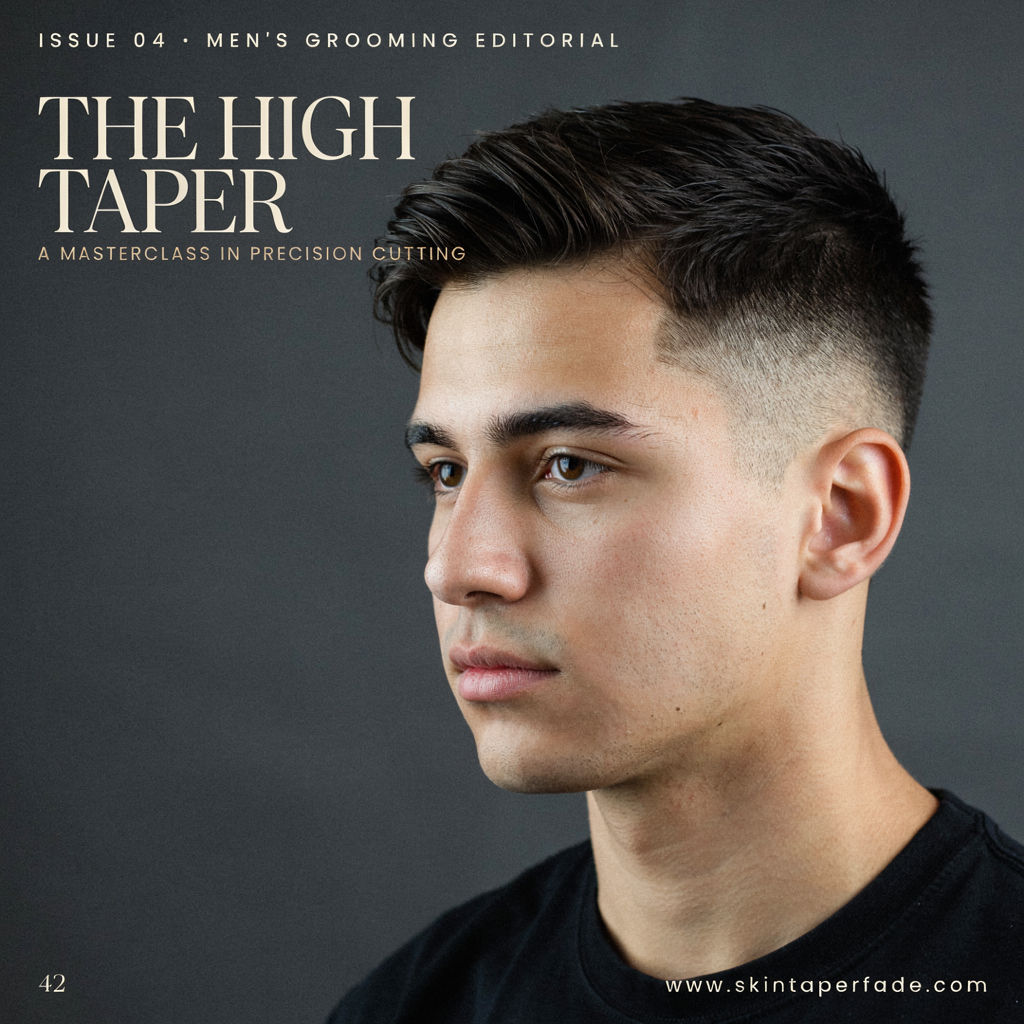
A high taper fade gives the edges of a haircut a sharper, more visible transition. The short blend rises higher at the temples and the back of the head than it would with a low or mid taper. That can make a curly top, textured crop or quiff stand out without necessarily turning the entire side of the head into a skin fade.
The key word is necessarily. Haircut labels vary between barbers, and pictures tagged “high taper” sometimes show a full high fade. Before you sit down, decide how much hair you want to keep on the sides, whether you want skin showing and how high the blend should reach. This guide walks you through those choices.
For a broader look at the haircut family, start with our complete guide to taper haircuts.
What is a high taper fade?
A high taper fade blends the hair shorter towards the temples, sideburns and neckline, with the transition placed higher than a low or mid taper. The effect is more pronounced, but the cut can still retain fullness on parts of the sides above or between the tapered areas.
High describes the placement of the transition. It does not automatically mean the bottom must be shaved to skin. Ask for a high skin taper if you want bare skin at the shortest point; ask to leave some visible hair if you prefer a softer finish.
No fixed measurement defines a high taper. A barber will adapt its height to your head shape, hairline and the style on top. Reference photos of the side and back are therefore essential.
What does a high taper look like from the front, side and back?
From the front, the hair near the temples is cut shorter and the top becomes more prominent. From the side, the blend is more obvious than on a low taper. At the back, the nape transitions into the hair above it; how far that transition rises depends on the look you request.
A high taper should be planned as part of the whole haircut. If the top is long and the sides are cut very close, you may want a stronger, almost disconnected contrast. If you want a smoother silhouette, ask your barber to leave enough length between the taper and the top.
High taper fade vs high fade
This is the most useful distinction to settle before a cut. In common usage, a high taper fade can concentrate the closest cutting near the temples and neckline, even though the blend rises relatively high. A high fade tends to carry a continuous short section much farther around both sides and the back.
| Feature | High taper fade | High fade |
|---|---|---|
| Main focus | Higher blends at the temples and nape | A higher blend across more of the sides and back |
| Hair kept on the sides | Can retain fullness between and above the tapered areas | Typically removes more side hair |
| Appearance from the side | Defined edges with some shape retained | Stronger, broader contrast |
| Skin finish possible? | Yes, if requested | Yes, if requested |
These are guides, not universal barbershop rules. If you want the hair above your ears preserved, point to it in a photo and tell your barber. If you want a continuous high fade all the way around, say that instead.
High vs mid vs low taper fade
All three names refer primarily to the height of the taper, although the exact positions vary between haircuts.
| Placement | General appearance | Consider it if you want… |
|---|---|---|
| Low taper | Blend stays near the sideburns and neckline | The most side fullness |
| Mid taper | Blend rises around the middle temples and nape | A more visible but balanced transition |
| High taper | Blend extends farther towards the upper temples and back | Clearer contrast and less bulk at the edges |
If you want to compare the other placements in detail, read our low taper fade and mid taper fade guides. Check those links against the live URLs before publishing this post.
High taper fade styles for different hair
High taper fade with curly hair
The higher blend draws attention to curls on top. This works especially well when you want a defined outline and plenty of height or forward movement. Discuss how much curl should remain around the upper sides: a higher cut removes more of the rounded shape than a low taper would. Ask your barber to consider curl shrinkage when choosing the final length.
High taper fade with Afro textured hair
A higher temple taper can give an Afro or shaped textured top a bolder outline. Decide how much width you want above the taper. A sharp line-up can emphasise the contrast, but it is optional; ask the barber to respect your natural hairline if you prefer an outlined front.
High taper fade with waves
A high placement may cut into the wave pattern at the sides. Show your barber where your waves form and which sections you want to preserve. If keeping the pattern is your priority, a lower taper may leave more of it visible.
High taper fade with straight hair
Straight hair often shows the change in length clearly. A high taper can frame a crop, quiff or side-swept top, provided the blend into the upper sides is deliberate. If you want a smooth connection rather than a disconnected look, say so before the barber removes weight.
High taper fade with wavy hair
A higher blend can emphasise a loose, wavy top. Keep enough length for the waves to form and decide whether the front will be worn forward or swept back. The shape on top matters as much as the taper height.
High taper fade with fine or thinning hair
The strong contrast of a high skin finish can make differences in density more obvious on some heads. That does not rule the cut out. Ask for a softer bottom length or more weight at the upper sides if that better balances your hair.
Popular high taper fade combinations
1. High taper fade with a textured crop
A textured crop puts movement on top while the higher taper clears bulk near the temples. This is a practical option if you want a distinct shape without spending much time styling. Ask for the fringe length that suits how your hair naturally sits.
2. High taper fade with a curly top
Leave the curls long enough to show their pattern. A short temple area increases contrast, especially from the front. Bring a photo with a curl type similar to yours so your barber can adapt the outline.
3. High taper fade with an Afro
The taper gives a shaped Afro more definition around the edges. The size and silhouette of the top should be decided first; the temple and nape blend then support that shape.
4. High taper fade with a quiff
A quiff needs length at the front and usually some daily styling. The higher taper makes the lift more noticeable. Ask how much upper-side weight to retain so the transition into the top does not feel abrupt.
5. High taper fade with a buzz cut
A short top and higher edge blend can create a sharp, simple haircut. Decide the length on top separately from the shortest area at the sideburns and nape. A skin finish will look markedly different from a dark, clipper-short one.
6. High taper fade with a beard
The sideburn can blend into the beard to connect the haircut and facial hair. Specify whether you also want the beard itself faded or would rather keep its fullness. The shape of the cheeks and neckline is a separate decision.
7. High skin taper fade
This version takes the lowest part of the taper down to skin. The higher placement makes the skin-to-hair transition noticeable. Show exactly how much skin you want visible, particularly at the temples, to avoid receiving a full high skin fade when you intended a targeted taper.
Should you choose a skin or non-skin finish?
A skin finish begins at bare skin and blends into longer hair. It gives the high taper more contrast and a crisp edge immediately after the cut. The exposed area will look different as soon as hair grows through it.
A non-skin finish retains visible hair at the shortest point. It can still look sharp while giving you a softer transition. This may be a better starting point if you want to try a high placement without committing to bare skin.
If close cutting has irritated your scalp before, let your barber know and discuss a less close finish.
How to ask your barber for a high taper fade
A photo is useful, but explain which part of the photo you like. You can say:
“I’d like a high taper fade at my temples and neckline. Please keep the blend higher than a mid taper, but leave some fullness through the upper sides. Keep about [your preferred length] on top. I want the bottom to [show skin / stay slightly dark], and I’d like a [natural / sharper] front hairline.”
Then confirm:
- Placement: Show how high you expect the temple and nape blend to rise.
- Coverage: Ask whether the short section will stay around the edges or continue across the whole side.
- Shortest length: Choose skin, a close clipper finish or a softer visible length.
- Upper-side weight: Tell the barber whether you want a smooth connection to the top or pronounced contrast.
- Outline: Decide on a natural hairline, line-up and any beard blend separately.
Do not rely on guard numbers alone. Blade settings, technique and your hair’s growth direction affect the result. Clear side and back photos plus these instructions are more reliable.
Styling and maintenance
Your daily routine depends mostly on the hair left on top. Work a small amount of matte product through a short crop, use a suitable curl product for a curly top or dry a quiff into position before adding hold. Tell your barber how much styling you normally do so the cut fits your routine.
A skin-short taper loses its crisp finish sooner than a softer taper. Check how yours looks after roughly two to four weeks and plan trims around your preferred level of sharpness. A natural hairline can make regrowth less conspicuous than a hard line-up, although every head of hair grows differently.
Be careful with home clippers around a high taper. A little extra cutting can widen the faded area or push it upwards into a full high fade. Ask your barber for an edge tidy-up if the top still looks good but the outline needs refreshing.
Common mistakes to avoid
Showing a full high fade when you want a taper. Choose photos that show the amount of hair you want retained above and behind the ears.
Assuming “high” means “skin.” Placement and shortest length are different choices.
Forgetting the back view. A high nape blend can change the haircut’s silhouette; show or describe your preference.
Taking too much from the upper sides. This can affect the shape of an Afro, curls or longer top. Agree on the full shape before cutting.
Choosing a high-contrast photo with a different hair texture. Treat it as an idea, then ask your barber how the shape will work with your own hair.
Frequently asked questions
Is a high taper fade the same as a high fade?
Usually not. A high taper can focus the close blend at the temples and nape while retaining more side hair. A high fade typically takes a broader section of the sides and back short. Labels vary, so use photos and specify coverage.
Does a high taper fade have to show skin?
No. You can request visible hair at the shortest point. Ask for a high skin taper if you specifically want bare skin.
Can a high taper fade work with curly hair?
Yes. It can frame a curly top with strong contrast. Tell your barber how much curl volume you want at the upper sides and how the curls sit when dry.
Will a high taper fade remove my waves?
It may remove part of the wave pattern on the sides if the blend reaches into that area. Show your barber the sections you want to keep before deciding on the height.
How often should I refresh a high taper fade?
It depends on your hair growth and how defined you want the edges. A skin finish or sharp outline shows regrowth sooner. Review it after a couple of weeks and choose a schedule based on the look you prefer.
Can I pair a high taper fade with a beard?
Yes. The sideburn can be tapered into the beard for a smooth connection. Tell your barber whether to fade the beard too or keep its main shape full.
Final thoughts
A high taper fade suits someone who wants a stronger outline while retaining control over how much of the sides are cut short. Decide on the height, coverage and skin finish before the appointment. Bring side and back photos and ask your barber to adapt the shape to your hair.
Compare more placements in our taper haircuts for men guide.