
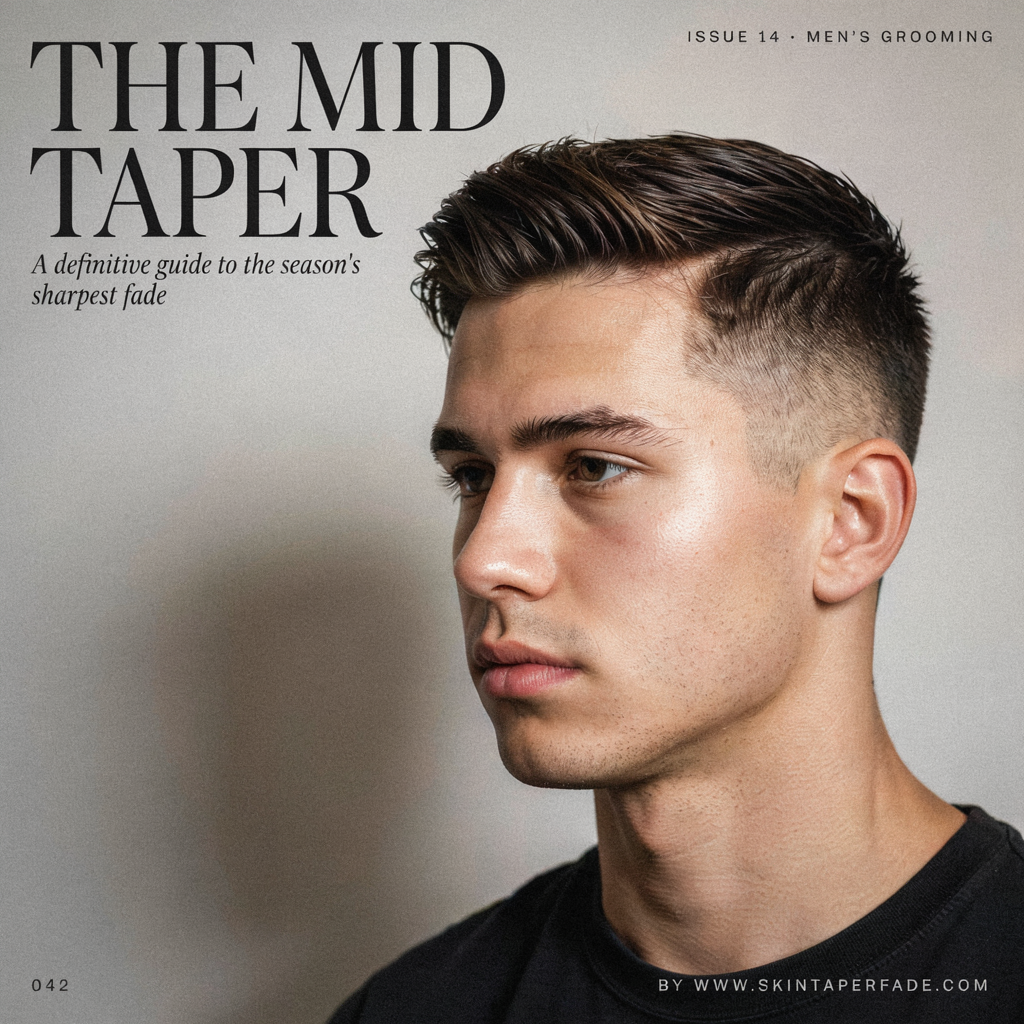
A mid taper fade gives you more visible contrast than a low taper while keeping much of the hair on the sides. The shorter blend sits around the middle of the temple area and rises from the neckline at the back. It can make a curly top look more defined, give a crop a cleaner edge or connect a haircut to a beard.
The name tells your barber where you want the transition, but it does not settle every detail. A mid taper can finish with a little hair still visible or with bare skin at the bottom. It can be narrow and subtle or spread across a wider area. This guide helps you choose the version you actually want.
For the wider family of styles, see our guide to taper haircuts for men.
mid taper fade
What is a mid taper fade?
A mid taper fade gradually takes the hair shorter around the temples, sideburns and nape. The shorter transition reaches higher than a low taper, so it is easier to see from the side, but it generally preserves more length through the upper sides than a broad mid fade.
Think of the haircut as two decisions:
- Placement: Mid describes roughly how high the taper sits.
- Finish: The shortest hair can remain visible or be taken to the skin.
There is no universal line on the head where a mid taper must start. Hairline position, head shape and the shape of the haircut above the taper change how the blend appears. Barbers also use these labels differently, which makes a side and back reference photo especially useful.
What does a mid taper fade look like?
From the front, the temples and sideburns look clean without necessarily removing all the hair above the ears. From the side, the transition is more noticeable than a low taper. From behind, the nape graduates into the longer hair above it. A good blend should look intentional from all three angles rather than like a short patch added to the side of another haircut.
Mid taper fade vs low taper fade
The main difference is the height of the blend. A low taper fade stays closer to the sideburns and neckline, leaving more fullness around the lower sides. A mid taper fade rises further, showing more of the transition and reducing more weight near the temples.
| Feature | Low taper fade | Mid taper fade |
|---|---|---|
| Blend position | Near the lower hairline and nape | Higher around the temples and back |
| Contrast from the side | Usually subtler | Usually more visible |
| Hair retained at the sides | More lower-side fullness | Less bulk around the temples |
| Skin finish possible? | Yes | Yes |
If you are unsure how high to go, ask your barber to begin conservatively and show you the shape before moving the taper upwards. Once the upper sides are cut short, the change cannot be undone during that appointment.
Mid taper fade vs mid fade
A mid fade usually carries a more continuous band of short hair around the sides and back. A mid taper fade often concentrates the closest cutting at the temples, sideburns and neckline while leaving more weight in between and above those areas.
These are useful descriptions, not rigid definitions. Some barbers use mid taper fade to describe a cut others would call a mid fade. Show where you want the short section to run: only at the edges, or all the way around the head.
Mid taper fade styles for different hair types
Mid taper fade with curly hair
A mid taper can reduce bulk near the temples and make the curls on top look more prominent. The exact height matters: take the taper too far into the curls and you may lose the rounded shape you wanted. Ask the barber to judge the top when the curls are sitting naturally, and discuss how much they shrink when dry.
Best detail to specify: Whether you want the sides to keep some curl above the blend or become closely cropped right up to the top.
Mid taper fade with Afro textured hair
The cut can sharpen the outline of an Afro or textured top while retaining height and volume above. A natural hairline, a shaped line-up and a faded beard are separate choices; you do not need all three. Tell the barber how much width you want to keep around the upper sides and ask them to follow your natural front hairline if you prefer a line-up.
Mid taper fade with waves
A mid taper gives the sideburns and neckline a clear finish while keeping the wave pattern on top. Explain your brushing pattern and the length you usually maintain. If waves continue down the sides, discuss whether the taper will remove part of that pattern before the cut starts.
Mid taper fade with straight hair
Straight hair can show the transition sharply, which makes a smooth blend particularly important. Pair a mid taper with a side part, crop or longer swept-back top. If your sides stick out as they grow, ask the barber to manage the weight above the taper rather than simply taking the blend higher.
Mid taper fade with wavy hair
Leave enough length for waves to form on top and around the upper sides. The mid taper cleans up the lower outline while the wave provides movement. A loose fringe or textured top can balance the sharper sides.
Mid taper fade with fine or thinning hair
A mid taper can work, but consider how much contrast you want between the top and the sides. A very close skin finish may make the top look more exposed on some people. You can keep the taper at a softer length and ask the barber to assess the shape with your own hair density.
Eight ways to wear a mid taper fade
1. Mid taper fade with a textured crop
A textured crop keeps the top relatively short with movement through the front. The mid taper gives it shape without requiring a large amount of styling. Ask for texture that suits how your hair naturally falls, rather than a heavy fringe that needs daily work.
2. Mid taper fade with a curly top
Let the curls supply the volume and keep the temples defined. Decide whether you want curls to fall forward or sit higher above the forehead. The answer affects how much length the barber should leave at the front.
3. Mid taper fade with a quiff
A quiff needs extra length at the front. The shorter temple area can make that height stand out. If you do not normally use a dryer or styling product, ask for a shorter, easier version of the quiff.
4. Mid taper fade with a side part
Keep enough length at the upper sides to comb into the part. A natural part gives a softer result, while a shaved part line is a more noticeable and separate design choice. Make that decision before the barber outlines it.
5. Mid taper fade with a buzz cut
Even when the hair on top is short, the taper can give the temples and neckline more definition than an even guard cut. Discuss the buzz length and the shortest taper length separately.
6. Mid taper fade with an Afro
Preserve the height and outline of the top while reducing weight around the middle temples. Bring a side-view reference showing the amount of width you want left above the blend.
7. Mid taper fade with a beard
The sideburn taper can flow into a beard fade for a connected appearance. Tell the barber whether to fade the beard itself or leave its main shape full. A beard outline and cheek line should be agreed separately.
8. Mid skin taper fade
This version takes the lowest part of the mid taper to bare skin. It produces a more defined transition and visibly grows out sooner than a softer finish. Specify how much skin you want showing, particularly around the temples and nape.
Skin finish or a softer finish?
Mid skin taper fade: The blend starts at bare skin and gradually becomes longer. Choose it if you like a crisp, higher-contrast edge and are happy for the fresh outline to change as it grows.
Mid taper with visible hair: The lowest section remains dark rather than exposing scalp. Choose it if you want the shape of a mid taper with a gentler transition.
A mid placement does not require a skin finish. If you have found very close cuts uncomfortable, tell your barber and ask for a less close bottom length.
How to ask your barber for a mid taper fade
Bring clear photos of the front, side and back. You can use this wording:
“I’d like a mid taper fade around the temples and neckline. Please take the blend higher than a low taper, but keep some fullness on the upper sides. Leave about [your preferred length] on top. I want the shortest part to [show skin / keep a little visible hair]. Please keep my front hairline [natural / neatly lined up].”
Before cutting, check these points:
- Height: Ask your barber to show where the shorter blend will reach at the temples and nape.
- Coverage: Confirm whether only the edges are tapered or the whole lower side will be faded.
- Bottom length: Decide whether the shortest point should show skin.
- Top shape: Explain how you style your hair on an ordinary day.
- Hairline and beard: Say whether either should be shaped or blended.
A guard number alone will not define the finished haircut. Barbers combine guards, blade settings and blending techniques, and hair grows in different directions. The reference photo and these decisions communicate more than saying “number two on the sides.”
Styling and upkeep
The taper itself usually needs little daily styling. The hair on top sets the routine. Work a small amount of matte paste through a crop, use a suitable curl product for a curly top, or direct a quiff with a dryer before adding product. Start with less product than you think you need and add more if the shape does not hold.
A skin-short mid taper will lose its freshly cut definition as the hair grows. A softer taper generally changes less abruptly. Look at the outline after roughly two to four weeks, then arrange visits according to your hair growth and the finish you prefer. Someone who likes a very sharp line-up may return sooner than someone who is comfortable with a natural grow-out.
Avoid taking the taper higher with home clippers just to tidy an edge. That can turn the shape into a broader fade. If the rest of the haircut still looks good, ask your barber whether a neckline and temple tidy-up is an option.
Common mistakes to avoid
Confusing height with closeness. A mid taper describes placement. Ask separately whether it should go to skin.
Using a photo of a full mid fade. If you want fullness through the sides, find a reference that shows it clearly.
Ignoring the back. Specify how high the nape taper should rise and whether the neckline should be natural or sharply outlined.
Removing too much weight above the blend. This can change the shape of curls, an Afro or a longer top. Agree on the overall silhouette first.
Choosing a style that demands more styling than you want to do. The taper may be easy to maintain, but a tall quiff or polished part needs its own routine.
Frequently asked questions
What is the difference between a mid taper fade and a low taper fade?
A mid taper sits higher around the temples and nape, making the blend more visible. A low taper stays closer to the edges and usually preserves more lower-side fullness.
Is a mid taper fade the same as a mid fade?
Usually, a mid fade shortens a broader area around the sides and back. A mid taper fade often focuses on the temple and neckline areas. Terminology differs between barbers, so show the coverage you want in a photo.
Does a mid taper fade have to show skin?
No. Ask for a mid skin taper if you want a bare-skin starting point. For a softer finish, ask for visible hair at the bottom of the blend.
Can I get a mid taper fade with curly hair?
Yes. It can frame curls and remove weight around the temples. Ask the barber to account for your curl pattern and how much volume you want left at the upper sides.
Can a mid taper fade work with a beard?
Yes. The sideburn can be blended into the beard, or the beard can be kept separate and full. Explain which finish you prefer.
How often does a mid taper fade need cutting?
That depends on hair growth and how crisp you want it to look. Skin finishes and sharp outlines become less defined sooner than soft, non-skin tapers. Review the shape after a few weeks and choose a schedule that suits you.
Final thoughts
A mid taper fade offers a noticeable transition without automatically removing all the hair from the sides. Choose the height of the blend, decide whether the bottom should show skin and tell your barber how much fullness to retain above it. Those choices, supported by clear photos, are what turn a haircut label into the cut you want.
Explore other placements and finishes in our taper haircuts guide.